Drainage Solutions
Standing water, soggy spots, washouts: graded, piped and fixed before the next big rain, not after it.
Learn more →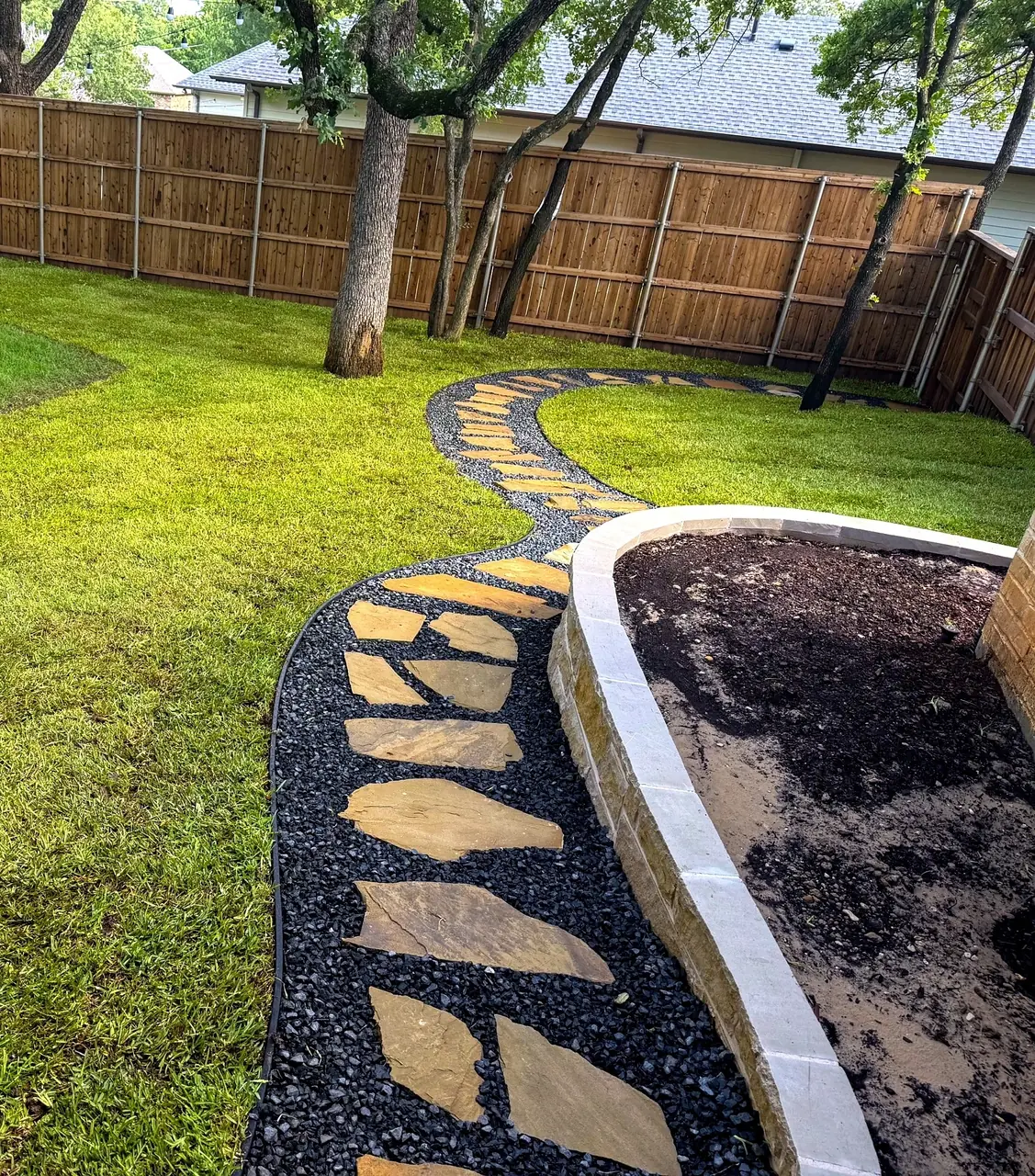
Acreage, post oaks, two completely different soils on the same property, and a town that will pay you to plant a tree.
Here is a genuinely striking fact: at the 2020 census, 99.7 percent of Argyle residents lived in territory the Census Bureau classifies as rural. Half an hour from DFW Airport.
That is the honest backbone of everything on this page. Argyle is not a subdivision town that happens to have some big lots. The town’s own description of its housing is “typical properties range from 1 to 2 acres, with many tracts of 5 to 10 acres or larger,” alongside “rolling pastures and large estate lots.”
It has grown enormously: from 90 residents in 1950 to 4,403 at the 2020 census, and considerably more since, but it has grown while keeping that character. New subdivisions are still being platted here at 2.5-acre minimum lot sizes.
This is the most practically useful thing we can tell you about an Argyle yard, and it is not true of any neighboring town.
We pulled USDA soil survey data for Argyle’s footprint. The two most extensive soils across town are sandy loams: Gasil and Callisburg, Eastern Cross Timbers soils weathered from the Woodbine sand formation, well to moderately well drained with moderate permeability. But Sanger, Navo, Wilson and Branyon are also widespread, and those are shrink-swell clay vertisols that behave nothing like the sandy loams.
Neighboring towns are far more uniformly clay. Argyle straddles the boundary.
A sandy-loam front yard and a clay back pasture on the same two-acre lot need **different irrigation run times, different aeration, and different soil amendment.** Sandy loam takes water faster and holds it less; the vertisol does the opposite. Running one irrigation program across both either drowns half your property or under-waters the other half. Almost nobody accounts for this, and it explains a lot of otherwise baffling turf behavior in Argyle.
The Town commissioned a Texas Trees Foundation urban forest assessment based on fifty field plots. The findings are specific and useful:
Why this matters for anyone doing work on your property: post oaks are unforgiving. They resent root-zone disturbance, soil compaction, grade change and overwatering. A large proportion of post oak decline around here is not disease. It is a driveway extension, a raised bed, a new irrigation zone, or a skid steer that crossed the root zone a few too many times.
On Argyle properties, the most valuable thing we do is often to tell you where not to build, dig or water.
And the calendar: do not prune oaks February through June. That is oak wilt’s high-risk window, and every oak wound gets painted immediately regardless of season.
Genuinely, and hardly anybody uses it.
| Trees | Size | Max quantity | Rebate each |
|---|---|---|---|
| Residents | 5-gallon | 5 | $50 |
| 15-gallon | 5 | $100 | |
| 30-gallon | 2 | $250 | |
| HOAs | 5-gallon | 10 | $50 |
| 15-gallon | 10 | $100 | |
| 30-gallon | 4 | $250 | |
| 45-gallon / 3-inch caliper | 2 | $400 |
Funded at $10,000 a year for residents and $10,000 for HOAs, first-come first-served. The application window is October 1 to March 1.
The conditions: you must own the property, trees must be planted within town limits and within fifteen days of purchase, not within ten feet of foundations, utility easements or sight lines, and you must call DIGTESS on 811 before digging. Approved species include live oak, bur oak, cedar elm, crape myrtle, pecan, post oak, sycamore and Texas persimmon: with the town flagging some as preferred for lower water use.
Argyle is also a Tree City USA community, which is the context for all of the above.
If you are planning planting work, timing it into that window is free money. We are happy to plan around the deadline.
The Town of Argyle does not supply water. Its own utility page names Argyle Water Supply Corporation as the provider and states explicitly that AWSC is not associated with the Town.
This is why searching the town website for watering days returns nothing, and why Argyle residents are frequently less certain about their restrictions than neighbors in cities with a municipal utility.
Confirm your current stage and schedule directly with AWSC on 940-464-7713. We are deliberately not publishing a schedule here: AWSC’s site did not render its current stage in a form we could verify, and a watering schedule is exactly the kind of thing that should not be guessed at.
Worth knowing separately: Cross Timbers Water Supply Corporation is headquartered in Argyle on Hickory Hill Road, and supplies Double Oak, Bartonville, Copper Canyon and parts of Highland Village and Flower Mound. CTWSC has reported that over 35 percent of its members had not completed the annual backflow testing Texas requires on irrigation systems: a useful prompt if nobody has ever tested yours.
Argyle zoning permits private stables and general farm or ranch use by right in the Agricultural, SF-2.5 and SF-1 districts, not by variance, by right. The Town describes itself as sitting within one of the largest concentrations of equestrian farms in the United States.
That changes the work:
The town’s own permit documentation sets them out plainly. Work is allowed Monday through Friday from 7:00 AM to 6:00 PM, and Saturday from 7:00 AM to 5:00 PM. No work is allowed on Sundays. Argyle states that it operates a zero tolerance policy on those hours and that first time violators will be cited.
We schedule Argyle work inside those hours. It is worth asking any contractor whether they do.
Across the town, including the master-planned communities, though note that Harvest and Canyon Falls both straddle municipal lines (Harvest into Northlake, Canyon Falls into Flower Mound and Northlake), so “our Argyle service area includes Harvest and Canyon Falls” is accurate while “Harvest is in Argyle” is only half the story. Knight’s Ridge and the older acreage properties along FM 1830 and US 377 are all inside our normal radius.
Everything below is work we do on Argyle properties. Each one goes to a page explaining how we actually approach it.
Standing water, soggy spots, washouts: graded, piped and fixed before the next big rain, not after it.
Learn more →New turf laid over properly prepped soil. The part most crews skip, and the reason sod fails.
Learn more →Mowing, edging, weed control and seasonal work on a schedule you can actually set your week by.
Learn more →Beds, plantings and layouts designed on your property, in person, not pulled from a catalog.
Learn more →Patios, walkways, retaining walls and outdoor kitchens built on base that holds up in clay soil.
Learn more →Shaping, thinning and clearance cuts that keep mature trees healthy instead of just smaller.
Learn more →Broken heads, stuck valves, dry patches and controllers that lost the plot: diagnosed and repaired.
Learn more →Path, uplight and architectural lighting that makes the work you paid for visible after sundown.
Learn more →Argyle is a short run west from Double Oak on FM 407, and Cross Timbers Water, who supply our own home town, are headquartered there.
Hours: Monday to Friday, 7am to 7pm. Saturday, 7am to 5pm. Closed Sunday.
Yes. The Town of Argyle runs a tree rebate program: $50 back on a 5-gallon tree (up to five), $100 on a 15-gallon (up to five) and $250 on a 30-gallon (up to two) for residents, with a larger schedule for HOAs including $400 on a 45-gallon or 3-inch caliper tree. It is funded at $10,000 a year for residents and $10,000 for HOAs on a first-come basis, and the application window runs October 1 to March 1. Trees must be planted inside town limits within fifteen days of purchase, not within ten feet of foundations, easements or sight lines, and you must call 811 before digging. Approved species include live oak, bur oak, cedar elm, crape myrtle, pecan, post oak, sycamore and Texas persimmon.
Because they may genuinely be different soils. USDA mapping shows Argyle straddling two soil worlds: the two most extensive soils across town are sandy loams: Gasil and Callisburg, Eastern Cross Timbers soils that drain moderately, while Sanger, Navo, Wilson and Branyon clays are shrink-swell vertisols that barely drain at all. Neighboring towns are far more uniformly clay. On a two-acre Argyle lot you can genuinely have both, and they want different irrigation run times, different aeration and different amendment.
Argyle is served by Argyle Water Supply Corporation, and the Town states plainly on its own utility page that it is not associated with the water supplier, which is why searching the town website for watering days finds nothing. Confirm the current stage and schedule directly with AWSC on 940-464-7713. We will not publish a schedule we have not been able to verify, and theirs is not published in a form we could read reliably.
This is the thing to get right in Argyle. A town-commissioned urban forest study found post oak making up about 30 percent of Argyle's tree population and the largest single share of its tree value. Post oaks are notably intolerant of root-zone disturbance, soil compaction, grade change and overwatering, so a lot of post oak decline here is not disease, it is a driveway extension, a raised bed or an irrigation zone installed with good intentions inside the root zone. Often the most valuable advice we give on an Argyle property is what not to do near the trees.
For protected trees, yes. The town's permit form requires a site plan showing exact location, caliper size, height and common name of every protected tree to be removed, plus written reasons. The specific protected species list and caliper thresholds should be confirmed with Community Development on 940-464-7273. We would rather you got that from the source than from us.
Argyle sets construction hours and enforces them: Monday to Friday 7am to 6pm, Saturday 7am to 5pm, and no work on Sundays. The town's own permit form states it has a zero tolerance policy on hours and that first-time violators will be cited. We schedule around that, and it is worth knowing if you are comparing contractors who may not.
Yes. Argyle zoning permits private stables and livestock or ranch use by right in the Agricultural, SF-2.5 and SF-1 districts, and the town describes itself as sitting within one of the largest concentrations of equestrian farms in the country. Paddock edges, arena surrounds, fence lines and pasture are a different maintenance proposition from lawn, and they get priced as such.
Real reviews from our Google profile. We do not attribute reviews to a city unless the customer named one themselves.
Justin was fair, transparent, on-time, and a great communicator. He spent time figuring out the mapping of my sprinkler…
Matt, thank you for trusting in us. Thank you for your service to our Country. From one Marine to another Semper Fi!
Justin and his team helped me out while on vacation. Great communication, fast service, and competitive pricing. Local small business! Thanks guys
Thank you Cory for trusting in us. We are here to help anytime you need us.
Very professional, friendly, easy to communicate with and does excellent work. I highly recommend this professional team!
Diane, we appreciate your trust in us as a company and you are very easy and friendly to work with as well. Thank you for being you!
Standing water and established weeds don’t settle down on their own. They get more expensive to fix the longer they sit. An estimate costs nothing and tells you what you’re actually dealing with.
Prefer to just talk? Call (469) 400-9581 and you’ll get Justin.
Tell us what the yard is doing. Justin will come out, walk the property, and scope it in person: no charge, no obligation.
Prefer to talk it through? Call (469) 400-9581. You’ll reach Justin.