Marine veteran & family-owned
5.0 on Google (30 reviews)
You reach the owner directly
Free on-site estimates
The one you see most and think about least
Through autumn and winter in North Texas, you leave for work before the light is good and get home after it has gone. Which means the landscaping you spent real money on is something you see properly at weekends, and your neighbors see in daylight.
Lighting changes that. It is also, unlike most landscape work, almost entirely additive. It does not disturb what is already there, and it can be extended as planting matures.
What lighting is actually doing
Good lighting design is not “put lights along the path.” It is deciding what should be visible and what should not:
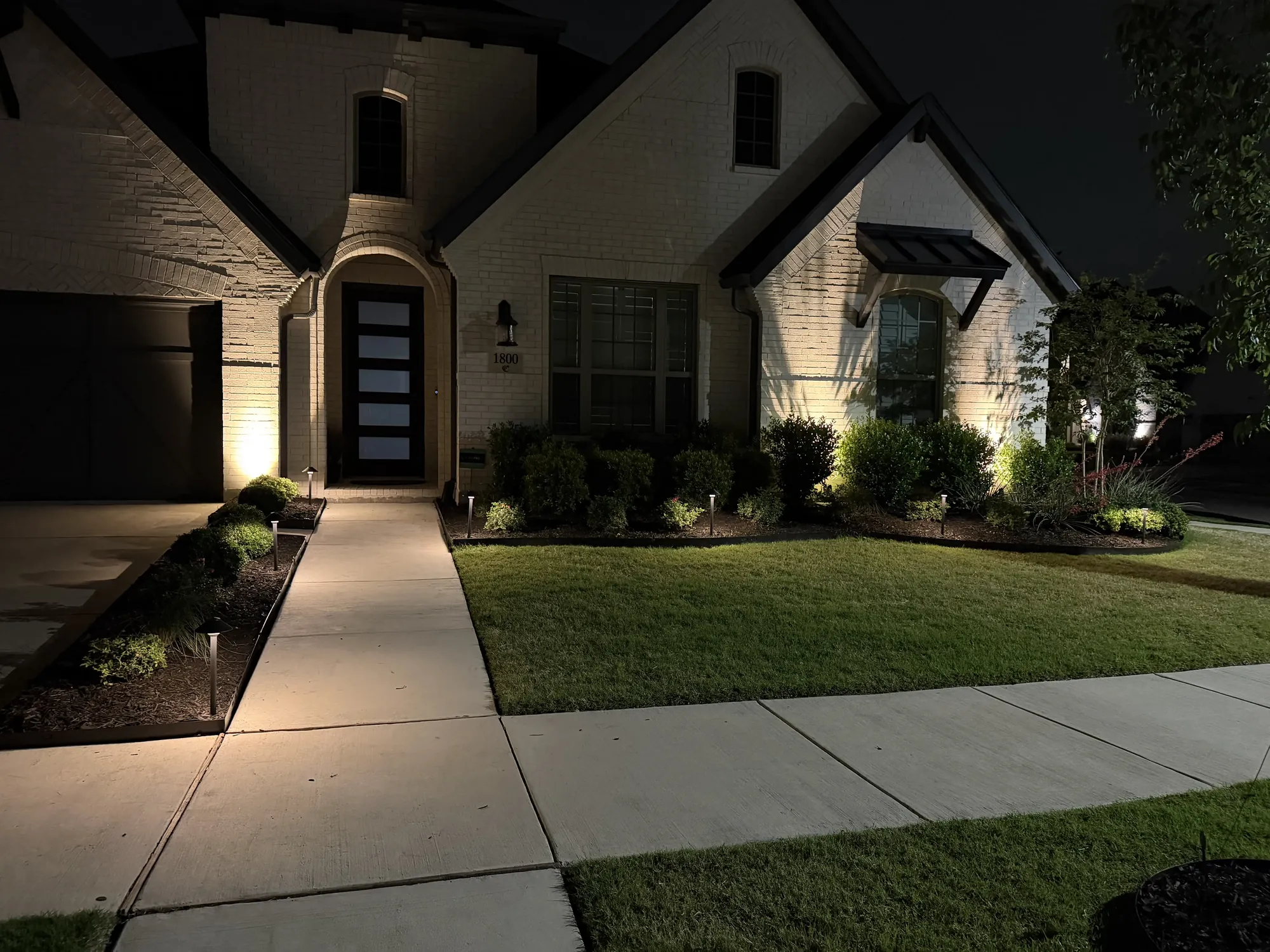
Uplighting: fixtures at the base of trees and architectural features, throwing light upward. This is what creates depth after dark, and on a mature specimen tree it is the most dramatic effect available.
Path and area lighting: low fixtures washing walkways, steps and level changes. As much a safety function as an aesthetic one, particularly on the sloped and terraced lots around Argyle and lake-adjacent Flower Mound.
Architectural washing: grazing light across stone and masonry to bring out texture. Especially effective on the stone and brick elevations common here.
Down lighting and moonlighting: fixtures mounted high in mature trees, casting dappled light downward. Subtle, expensive to do well, and the most natural-looking effect there is.
Security lighting. The practical layer. Eliminating the dark approaches to a property without lighting it like a car park.
The skill is restraint. Over-lit properties look like retail. The aim is a few well-placed effects and a lot of deliberate darkness in between.
Why we do this in-house
Lighting is where a landscape company either understands the whole property or does not. Cable routing has to work around irrigation lines, drainage runs and root zones. Fixture placement has to anticipate how planting will grow over five years. And the transformer has to be sized for what you might add later, not just what goes in now.
Because we do the drainage, the irrigation repair and the planting, we know where everything already is. A lighting-only contractor arriving at a finished property is working blind, which is how irrigation lines get cut and cable gets routed straight through a root zone.
What a system is made of
Transformer. Steps mains down to twelve volts. Size it with headroom or you cannot expand later.
Cable. Direct burial, correctly gauged for the run length. Voltage drop over a long run is the most common reason distant fixtures look dim.
Fixtures. This is where quality shows. Cast brass and copper age gracefully and stay watertight. Inexpensive alternatives corrode, fog and fill with water. Given that these live outside permanently, it is not the place to economise.
Control. Timer, photocell, or app control. Astronomical timers that track sunset through the year are worth the small extra over a fixed clock.
Honest note
Landscape lighting is the service on our list with the least search demand behind it locally: people do not go looking for it the way they go looking for drainage help. It stays on the list because it is genuinely one of the best things you can do to a property, and because the properties around Double Oak, Argyle and Flower Mound, with their acreage, mature trees and stone elevations, are unusually well suited to it.
If you have had hardscape or planting done and it disappears at sundown, this is the fix.
What this usually costs
A typical low-voltage system
$2,500 to $8,000
A handful of path lights and a couple of uplights sits at the bottom. A full property scheme with transformer capacity to expand sits at the top.
This is a starting reference, not a quote. Pricing is case by case because every property is different. Grade, soil, access, lot size and what is already in the ground all move the number, and the only way to get a real one is an on-site look. That visit is free.
It is the highest-impact thing you can do to a property per dollar spent, for a simple reason: for a large part of the year you leave in the dark and come home in the dark, so the lighting is the version of your landscaping you actually see most. It also does two practical jobs: makes steps, level changes and walkways safe, and makes the property a good deal less appealing to approach unseen.
Low voltage or line voltage?
Low voltage for residential landscape work, effectively always. It runs on twelve volts through a transformer, which makes it far safer around a yard where people dig, and it means fixtures can be moved or added later as planting matures without rewiring the property. Line voltage has its place in commercial work; in a garden it is unnecessary risk.
Will it raise my electricity bill?
Barely. Modern low-voltage LED fixtures draw very little: a whole system typically runs at a fraction of what a single old halogen floodlight used. The old objection to landscape lighting was running cost, and LED effectively removed it.
How long do the fixtures last?
Quality matters here more than almost anywhere else in landscaping, because the fixtures live outdoors permanently. Cast brass and copper fixtures weather rather than fail and last many years. Inexpensive aluminium and plastic fixtures corrode, fog and fill with water, usually within a few seasons. The cheaper install is genuinely cheaper right up until you replace all of it.
Can you add to a system I already have?
Usually, yes. That is one of the advantages of low voltage. The limit is transformer capacity and existing cable runs. We will check whether your current transformer has the headroom before adding load to it.
What about lighting around mature trees?
Uplighting mature trees is the single most dramatic thing landscape lighting does, and it needs care on species like post oak that are sensitive to root disturbance. Fixtures and cable get placed to avoid cutting into the root zone.
Reviews
What Customers Say About This Work
Justin was fair, transparent, on-time, and a great communicator. He spent time figuring out the mapping of my sprinkler…
Justin replied
Matt, thank you for trusting in us. Thank you for your service to our Country. From one Marine to another Semper Fi!
Justin and his team helped me out while on vacation. Great communication, fast service, and competitive pricing. Local small business! Thanks guys
Justin replied
Thank you Cory for trusting in us. We are here to help anytime you need us.
Great price
Very professional, friendly, easy to communicate with and does excellent work. I highly recommend this professional team!
Justin replied
Diane, we appreciate your trust in us as a company and you are very easy and friendly to work with as well. Thank you for being you!