Marine veteran & family-owned
5.0 on Google (30 reviews)
You reach the owner directly
Free on-site estimates
What this service covers
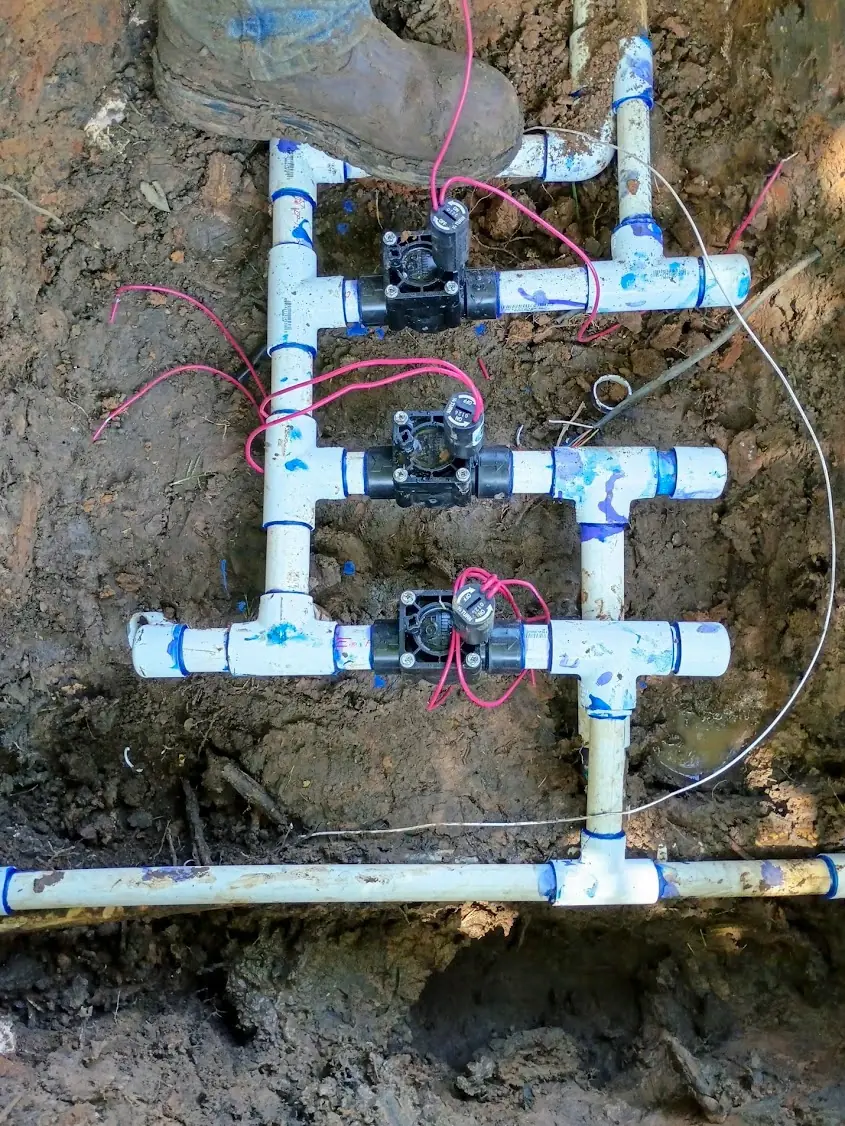
Repair and troubleshooting on existing sprinkler systems. Heads, nozzles, valves, solenoids, lateral leaks, coverage problems and controllers. Diagnosis comes first, parts second. If what your property needs falls outside repair work, we will tell you straight and point you toward the right trade.
Diagnosis before parts
The fastest way to spend money on irrigation without fixing anything is to replace components before understanding the fault. A dry patch gets a new head; the patch stays dry, because the actual problem was a partly closed valve two zones upstream or a nozzle throwing the wrong arc into a shrub that has grown four feet since the system went in.
So the first visit is diagnostic. Every zone gets run manually and watched, start to finish. That is genuinely the only way to see a valve that fails to close, a head that sinks below grade under pressure, or an overlap gap that only appears when the neighboring zone is off.
What usually turns out to be wrong
Broken, sunken or blocked heads. The obvious category. Mower damage, settled soil, and heads that were correct at installation and are now behind a mature shrub.
Valves that will not close. Debris in the diaphragm or a failed solenoid. Symptom is a zone that keeps running or weeps continuously, and it is one of the most common causes of an unexplained bill increase, because the cycle usually runs while everyone is asleep.
Lateral line leaks. Frequently created by somebody else’s trenching: drainage work, fencing, and landscape installation all cut irrigation lines regularly. Shows up as a soft patch, or grass that is suspiciously greener in one spot.
Coverage that was never right, or is no longer right. Especially on the larger lots around Double Oak and Argyle, where a system scaled for the original planted area now has to cover considerably more ground.
Controllers. Power interruptions reset programs to defaults, and defaults are often several start times per day. Plenty of “my system is broken” calls turn out to be a controller quietly running a schedule nobody chose.
Backflow assemblies. Freeze damage, and the annual testing requirement most people are unaware of.
Watering restrictions, which change what “working” means
There is little point tuning a system without knowing what it is legally allowed to do.
Most of this service area is under mandatory outdoor watering restrictions, and, unusually, they do not all come from city government:
Double Oak, Bartonville, Copper Canyon and parts of Highland Village and Flower Mound are served by Cross Timbers Water Supply Corporation, a member-owned co-op. It is currently in Stage 2: no outside watering between 6am and 7pm, with days assigned by the last digit of your address: odd Monday, Wednesday, Friday; even Tuesday, Thursday, Saturday.
Argyle is served by Argyle Water Supply Corporation. The Town of Argyle states explicitly that it is not associated with the water supplier, which is why searching the town website for watering days finds nothing.
Flower Mound and much of southern Denton County run a twice-weekly schedule with no automatic irrigation between 10am and 6pm.
Stages change with conditions, so confirm yours directly with your provider. But the practical point stands: a controller programmed for a schedule you are not allowed to run is a violation waiting to happen, and a system that has to deliver a week’s water in two permitted windows needs to be efficient in a way that a system watering daily never did.
Backflow testing: a compliance gap worth knowing about
Texas requires annual testing of irrigation backflow prevention devices. Cross Timbers Water Supply Corporation reported that more than thirty-five percent of its members had not completed the required testing, which is to say, this is not an obscure technicality that a handful of people miss.
If you have never been asked about yours, it is worth finding out where you stand.
Highland Village specifically
Highland Village is worth a note because its irrigation problems cluster in a way most towns’ do not. Highland Shores alone was more than eighteen hundred homes developed from a single build wave starting in the mid-1980s, which means a large number of systems installed within a few years of each other. Valves, solenoids and controllers therefore reach end of life in waves rather than spread evenly, and if your neighbors are suddenly all having sprinkler trouble, that is why.
What this usually costs
A typical repair visit
$150 to $600
A diagnostic visit with a head or two replaced sits low. Multiple failed valves, a lateral line leak or a controller replacement sits high.
This is a starting reference, not a quote. Pricing is case by case because every property is different. Grade, soil, access, lot size and what is already in the ground all move the number, and the only way to get a real one is an on-site look. That visit is free.
My water bill jumped and I cannot see a leak. What is going on?
Usually one of three things. A stuck valve that keeps a zone running after the controller has moved on, which you will never see if the cycle runs before dawn. An underground lateral leak, which shows as a soft or unusually green patch long before it surfaces. Or a controller that reset itself after a power blip and reverted to a default program, often several start times a day. Running each zone manually and watching is how we tell which.
Why is one part of the lawn always dry?
Most often coverage rather than pressure. Sprinkler layouts are designed for head-to-head coverage, and when one head is blocked, sunk below grade, tilted, or the wrong nozzle for its arc, the overlap breaks down and you get a dry wedge. Shrubs that have grown since installation are a very common culprit. On larger lots the other cause is a system originally scaled for a smaller planted area than the property now has.
What is backflow testing and do I need it?
Texas requires annual testing of the backflow prevention device on an irrigation system. It stops irrigation water being drawn back into the drinking supply. It is a genuine public health requirement rather than paperwork. It is also widely ignored: Cross Timbers Water Supply Corporation reported that over thirty-five percent of its members had not completed the required testing. If you have never had yours tested, you are in that group.
What sprinkler work do you take on?
Repair and troubleshooting on systems that are already in the ground. Broken, sunken and blocked heads, stuck valves and failed solenoids, lateral line leaks, dry zones and coverage gaps, and controllers that have drifted off schedule. We diagnose before we replace parts, because the fastest way to spend money on a sprinkler system is to swap components before anyone has worked out what is actually wrong. If your project falls outside repair work, we will tell you straight and point you toward the right trade.
When do I need to worry about freezing?
North Texas gets hard freezes that catch people out because the season is short. Exposed backflow assemblies and above-ground components are the vulnerable parts. Insulating them before the first hard freeze is a small job compared with replacing a cracked assembly.
How do I know which watering schedule applies to me?
By finding out who actually supplies your water, which is less obvious here than it should be. Double Oak, Bartonville and Copper Canyon are on Cross Timbers Water Supply Corporation. Argyle is on Argyle Water Supply Corporation, and the town states plainly that it is not associated with it. Flower Mound and much of southern Denton County fall under Upper Trinity. Four authorities, four sets of rules, none of them necessarily on your city website.
Reviews
What Customers Say About This Work
Justin was fair, transparent, on-time, and a great communicator. He spent time figuring out the mapping of my sprinkler…
Justin replied
Matt, thank you for trusting in us. Thank you for your service to our Country. From one Marine to another Semper Fi!
Great price
Very professional and responds promptly. I definitely recommend these guys for any yard maintenance. The prices are…
Justin replied
Thank you Abel! Glad we were able to get you on our maintenance route. We look forward to getting your irrigation fixed up this week. We are very grateful you have chosen us to serve you.
Justin and his team helped me out while on vacation. Great communication, fast service, and competitive pricing. Local small business! Thanks guys
Justin replied
Thank you Cory for trusting in us. We are here to help anytime you need us.