Marine veteran & family-owned
5.0 on Google (30 reviews)
You reach the owner directly
Free on-site estimates
Why this happens here specifically
Denton County sits on Blackland Prairie and Grand Prairie clays: expansive vertisols with very slow permeability. Water does not soak into them at any useful rate. It sits on top and moves downhill, or it sits on top and stays.
That is the whole mechanism, and everything else follows from it:
Rain here arrives fast. North Texas gets long dry spells punctuated by three-inch downpours. Soil that absorbs slowly plus rain that arrives quickly equals water on the surface with nowhere to go.
The clay moves. Expansive clay swells when it takes on water and shrinks when it dries. That cycle is what puts pressure against a slab, and why drainage in this market is sold as foundation protection rather than as landscaping.
Grading is everything. In sandy soil you can get away with mediocre grade because the ground absorbs the difference. Here you cannot. Fall, and a place for the water to end up, are the entire job.
If a company tells you the fix for standing water in Double Oak is aeration or a soil amendment, they are treating a symptom of geology as a lawn care issue.
What we actually install
Most jobs are a combination of these rather than one of them:
French drains. A gravel-wrapped perforated pipe in a trench that intercepts subsurface and surface water and carries it somewhere useful. The two things that determine whether it works in five years are pipe spec and fall.
Catch basins. Grated inlets set in the low spots that collect surface water directly. Inexpensive relative to what they solve, and frequently the difference between a yard that puddles and one that does not.
Downspout tie-ins. Your gutters concentrate an enormous volume of roof water at a handful of points. If those discharge onto the ground next to the house, you have engineered a problem. Burying them and carrying that water away from the foundation is often the highest-value part of a drainage job.
Regrading. Sometimes the answer is not pipe at all. It is re-establishing fall away from the structure. Less glamorous, frequently more effective.
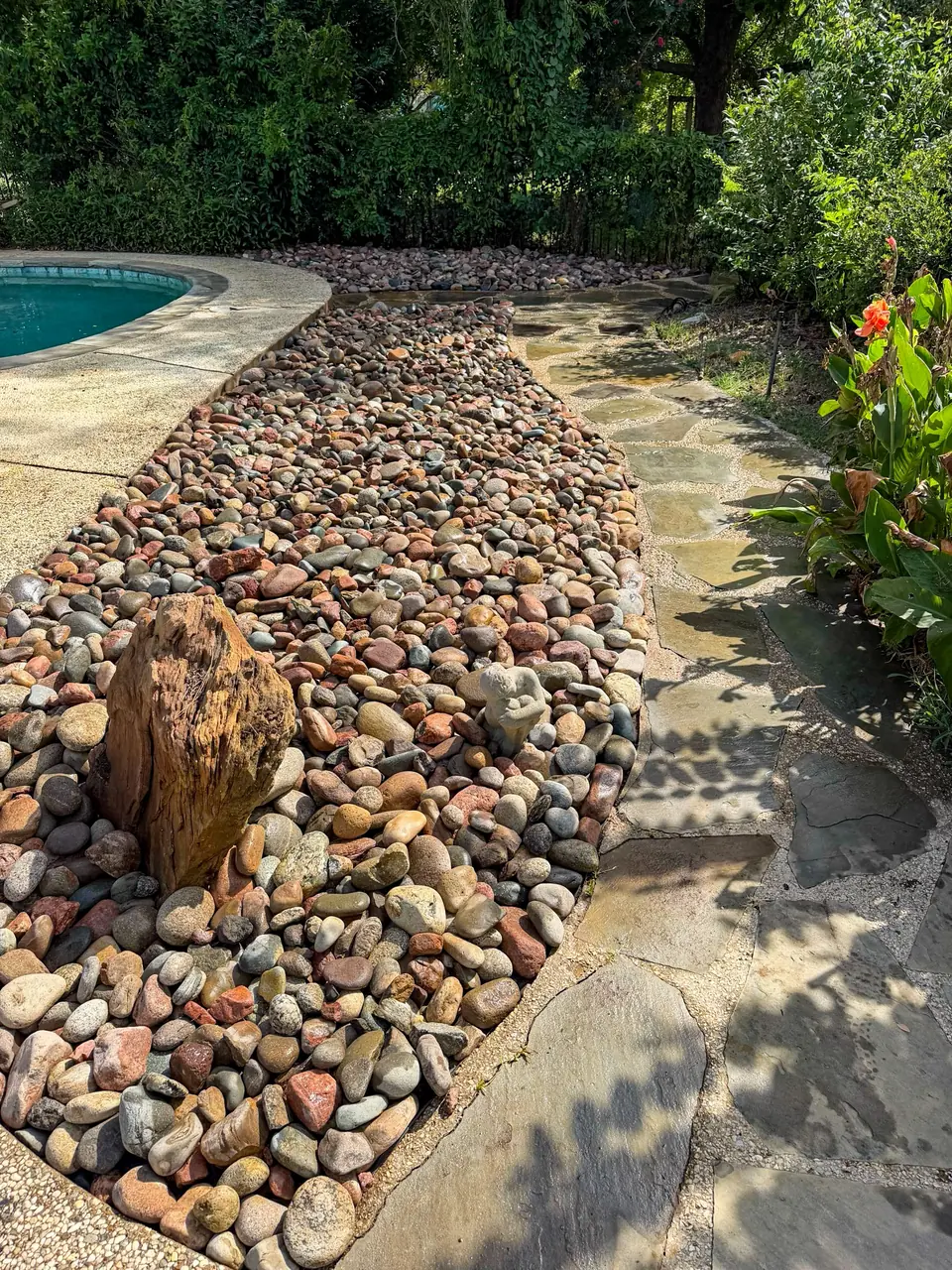
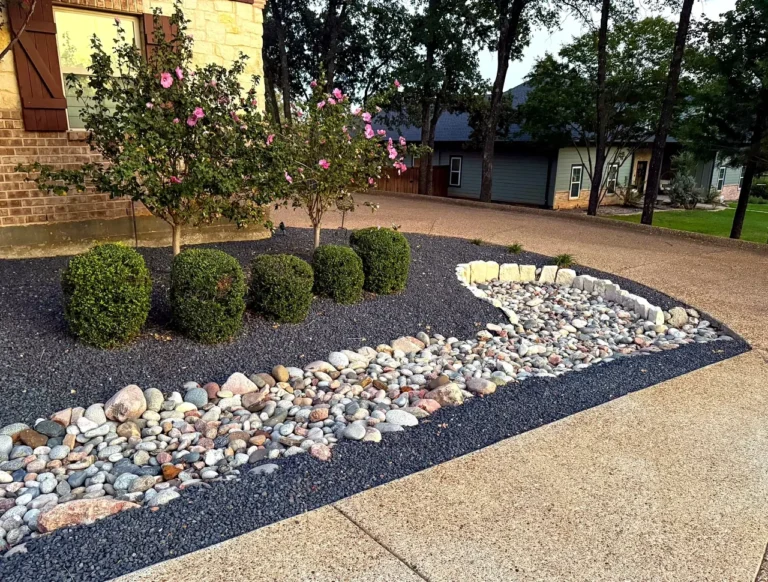
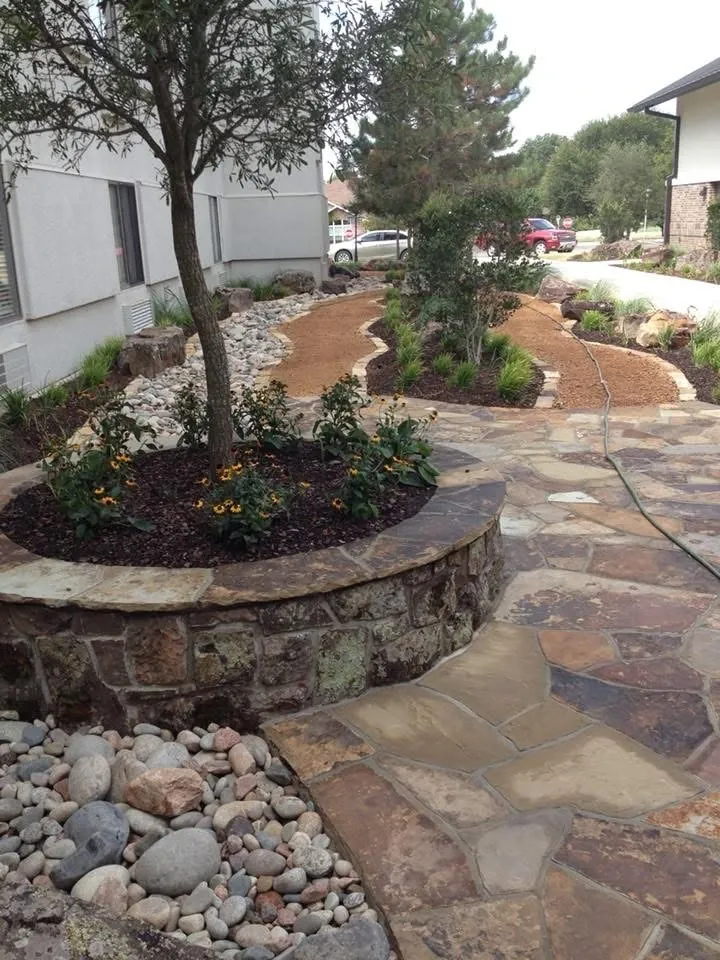
Swales and dry creek beds. Where a surface conveyance route makes more sense than a buried one, and where it can be made to look deliberate rather than remedial.
Discharge. Every one of the above is worthless without somewhere for the water to go. A daylight outfall, a pop-up emitter, or a permitted curb core. Systems that end nowhere are a real thing we get called out to replace.
The part of the bid you cannot see
Here is the honest version of why quotes vary so much.
Once the trench is backfilled and the sod is over it, a system built with corrugated flex pipe and a system built with rigid PVC look identical. They do not behave identically. Flex pipe’s ridged interior catches silt, and in clay country there is a lot of silt, so it loses capacity over time. It also deforms under load.
The same applies to depth, to whether the gravel is properly wrapped in filter fabric, to whether cleanouts were installed, and to whether the downspouts were genuinely tied in or just pointed vaguely at the new drain.
We would rather show you the spec on the estimate and let you compare like for like than win a bid by quietly using the lesser version.
Two bids, thousands apart
When you are comparing drainage quotes, ask each one: what pipe, what diameter, how deep, how many catch basins, are downspouts tied in, where does it discharge, and are there cleanouts. If a bid cannot answer those in writing, the difference in price is not efficiency.
How we scope it
Drainage is the one service where a quote given over the phone is close to meaningless. We need to see fall, and where water actually goes, which is why photographs of the yard during a heavy rain are the single most useful thing you can send us. Most people never think to take them, and they tell us more than a dry-day walkthrough ever will.
On site, Justin walks the low points, checks the grade away from the foundation, looks at where every downspout terminates, and works out where the water can legally and practically be sent. Then you get a scope and a number.
What it costs
Drainage is the service where published North Texas pricing is most consistent: three independent local sources converge on roughly the same per-foot figure. We have written all of it up, including what pushes a job to the top of the range.
What this usually costs
Most residential drainage projects
$1,500 to $8,000
A single stubborn low spot sits at the bottom of that. A whole-property system with gutter tie-ins, regrading and a permitted discharge point sits at the top, and complex sites can run beyond it.
This is a starting reference, not a quote. Pricing is case by case because every property is different. Grade, soil, access, lot size and what is already in the ground all move the number, and the only way to get a real one is an on-site look. That visit is free.
We publish an honest cost guide for this service: real North Texas market ranges, what the low end actually buys you, and what pushes a number up. No sign-up, no email gate.
How long should water sit in my yard after a storm?
A well-draining yard sheds standing water within a few hours of the rain stopping. In heavy North Texas clay, up to about 24 hours in the lowest spot after a genuinely large storm is not alarming. Water still sitting at 48 hours, or a patch that stays soft and spongy for a week, means water has nowhere to go. That is a grade or conveyance problem, not slow soil.
Will a French drain fix my foundation problem?
It can protect a foundation, but it does not repair one. What drainage work does is stop the wet-dry cycle that makes expansive clay swell and shrink against your slab. If you already have visible foundation movement, you need a foundation engineer, and drainage correction is usually part of what they recommend afterwards, not a substitute for it.
Why are two drainage quotes thousands of dollars apart?
Most often, pipe. Corrugated flexible pipe is far less expensive than rigid SDR-35 or Schedule 40 PVC, and from the surface once the trench is closed you cannot tell which one you bought. Flex pipe has ridged walls that catch silt and it deforms under load. The other big variables are trench depth, whether downspouts are actually tied in, and whether there is a real daylight discharge point or the pipe just ends somewhere hopeful.
Do I need a permit to drain water to the street?
Cutting through a city curb to discharge is a permitted act in most Denton County municipalities, and requirements differ from town to town. We handle that as part of the job and will tell you up front if your discharge point needs one.
Will you tear up my whole lawn?
Trenching leaves a scar across whatever it crosses. There is no version of this that is invisible on day one. We keep runs as tight as the hydraulics allow, and restoration is quoted as part of the work rather than discovered afterwards. On established properties expect us to hit irrigation lines; it is close to unavoidable, and repairing them is part of the job, not a change order.
Can you fix it without digging up the patio?
Sometimes. If the water can be intercepted upstream of the hardscape, we would rather do that. If the only viable route is under a patio or driveway, we will tell you what cutting and restoring it adds before you decide.
Reviews
What Customers Say About This Work
Justin and his team did an amazing job replacing our French Drains! Highly recommend them for any large landscaping project.
Justin replied
Brent, thank you for trusting in us! We are pleased to hear you love the work. Thank you for being such a great customer.
Great price
Justin and his team just completed a huge overhaul of our backyard that was struggling with holding water, mud, and just…
Justin replied
Thank you so much for your kind words! Our team loved transforming your yard and making it enjoyable again.
Reasonable price
Quick response and kept me updated on installation timeline. Liked the recommendations for the drainage issue we were experiencing.
Justin replied
Thanks so much for your kind words! Our team is glad we could help with the drainage. We are here also in the future if you need anything at all! Also, thank you for your service to our Country.