Drainage Solutions
Standing water, soggy spots, washouts: graded, piped and fixed before the next big rain, not after it.
Learn more →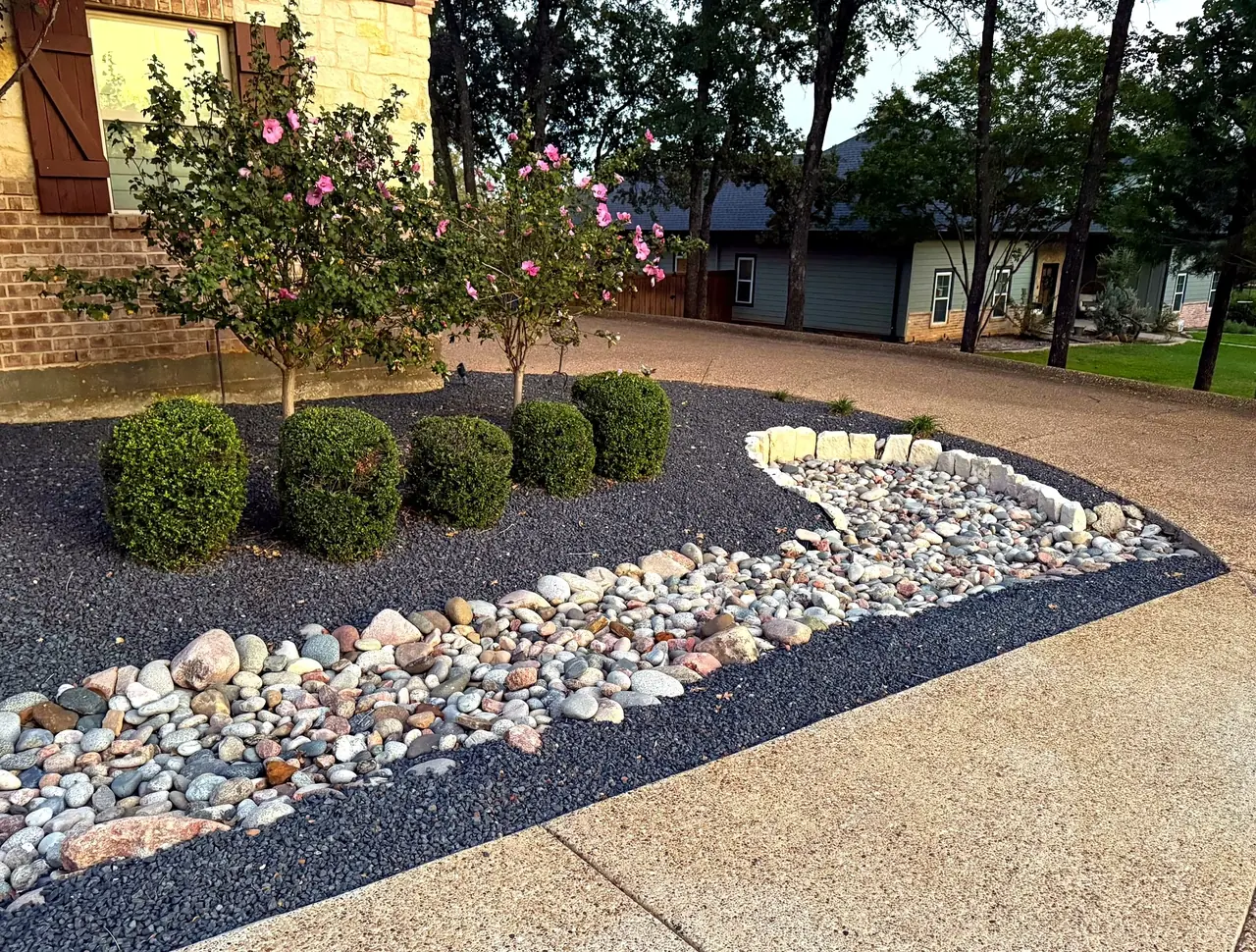
The county seat, and the town that gave its name to a USDA soil series that explains a great deal about local yards.
Most local landscaping claims are regional generalizations wearing a city name. This one is not.
There is a recognized USDA soil series called Denton: a clayey soil formed over limestone bedrock, named for this county. That is about as locally specific as soil facts get, and it has real consequences:
Clay over rock behaves differently from deep clay. Water moving down through the profile eventually meets limestone. Instead of continuing to drain, it can perch above the rock layer. Practically, that means solutions relying on downward infiltration are less reliable here, and surface or shallow conveyance is often the better answer.
Root depth is constrained. Trees and turf can only establish as deep as the profile allows. That affects drought resilience, what species make sense, and how much a lawn depends on consistent surface moisture.
If you have ever wondered why a spot in your Denton yard stays wet long after the surrounding ground has dried, the bedrock is a very plausible reason.
Denton is the county seat and home to two universities, the University of North Texas and Texas Woman’s University, which gives it a character nothing else in our service area shares: a genuine college-town core wrapped in suburban growth.
The result is the widest internal range of property types we deal with:
Those want genuinely different work. A rental near campus and a family home in The Preserve at Pecan Creek are not the same landscaping problem, and pretending otherwise produces plans that fit neither.
The newer subdivisions on Denton’s edges have the same issue as every recently-built area in North Texas: construction traffic compacts the ground badly, topsoil quality varies by builder, and sod frequently goes down over subsoil rather than anything that deserves the name.
That produces lawns that look excellent at handover and thin out within two summers. The fix is soil, not more fertiliser, and it is a great deal cheaper to address before the sod goes down than after.
Denton’s older neighborhoods carry substantial tree cover, and mature trees are both the best feature of those properties and the biggest constraint on them.
Two things worth knowing:
Oak wilt sets the calendar. Do not prune oaks between February and June. That is when the beetles carrying the fungus are active and a fresh cut is an invitation. Paint every oak wound immediately, year-round.
Iron chlorosis is common here. Yellow leaves with green veins on an otherwise healthy tree usually means iron the roots cannot reach, because alkaline clay locks it up. Red oaks and pin oaks are especially prone across this region. It is treatable, and it is frequently mistaken for something more serious.
Everything below is work we do on Denton properties. Each one goes to a page explaining how we actually approach it.
Standing water, soggy spots, washouts: graded, piped and fixed before the next big rain, not after it.
Learn more →New turf laid over properly prepped soil. The part most crews skip, and the reason sod fails.
Learn more →Mowing, edging, weed control and seasonal work on a schedule you can actually set your week by.
Learn more →Beds, plantings and layouts designed on your property, in person, not pulled from a catalog.
Learn more →Patios, walkways, retaining walls and outdoor kitchens built on base that holds up in clay soil.
Learn more →Shaping, thinning and clearance cuts that keep mature trees healthy instead of just smaller.
Learn more →Broken heads, stuck valves, dry patches and controllers that lost the plot: diagnosed and repaired.
Learn more →Path, uplight and architectural lighting that makes the work you paid for visible after sundown.
Learn more →Denton is about a twenty-minute run north from Double Oak, and it is a regular stop on our route rather than an occasional trip.
Hours: Monday to Friday, 7am to 7pm. Saturday, 7am to 5pm. Closed Sunday.
It is a recognized USDA soil series named for this county: a clayey soil formed over limestone bedrock. That structure matters practically: clay over rock changes both how water moves through the profile and how deep root systems can establish. It is the reason drainage advice that works on deep clay elsewhere does not always translate directly here, and it is a genuinely local fact rather than a regional generalization.
It changes what properties need rather than how we work. Denton has UNT and TWU, and the rental and investment properties near them tend toward lower-maintenance, curb-appeal-driven landscaping on a different cycle than an owner-occupied family home. Both are perfectly good work; they just want different plans.
Across the city: Carroll Park, The Preserve at Pecan Creek, Oakmont, Southridge and Denia among others, along with the historic core and the newer development on the periphery. Denton genuinely contains both extremes of housing age within one city limit.
Somewhat. Older neighborhoods were graded to older standards, and mature tree cover adds root systems that both help and complicate water movement. Add the limestone influence and you get situations where water perches rather than draining down, which points toward surface conveyance rather than deep infiltration.
Yes, and the older core is full of mature trees that need it. The important constraint is the calendar: oaks should not be pruned February through June because of oak wilt, and any oak wound needs sealing immediately regardless of season. We schedule around it rather than through it.
Real reviews from our Google profile. We do not attribute reviews to a city unless the customer named one themselves.
Justin was fair, transparent, on-time, and a great communicator. He spent time figuring out the mapping of my sprinkler…
Matt, thank you for trusting in us. Thank you for your service to our Country. From one Marine to another Semper Fi!
Justin and his team helped me out while on vacation. Great communication, fast service, and competitive pricing. Local small business! Thanks guys
Thank you Cory for trusting in us. We are here to help anytime you need us.
Very professional, friendly, easy to communicate with and does excellent work. I highly recommend this professional team!
Diane, we appreciate your trust in us as a company and you are very easy and friendly to work with as well. Thank you for being you!
Standing water and established weeds don’t settle down on their own. They get more expensive to fix the longer they sit. An estimate costs nothing and tells you what you’re actually dealing with.
Prefer to just talk? Call (469) 400-9581 and you’ll get Justin.
Tell us what the yard is doing. Justin will come out, walk the property, and scope it in person: no charge, no obligation.
Prefer to talk it through? Call (469) 400-9581. You’ll reach Justin.