Stuck to budget, stuck to timeline, 100% pricing transparency, can't ask for much more than that!…
Justin replied
Thank you for your review! We're glad you appreciated our transparency and timeline adherence.
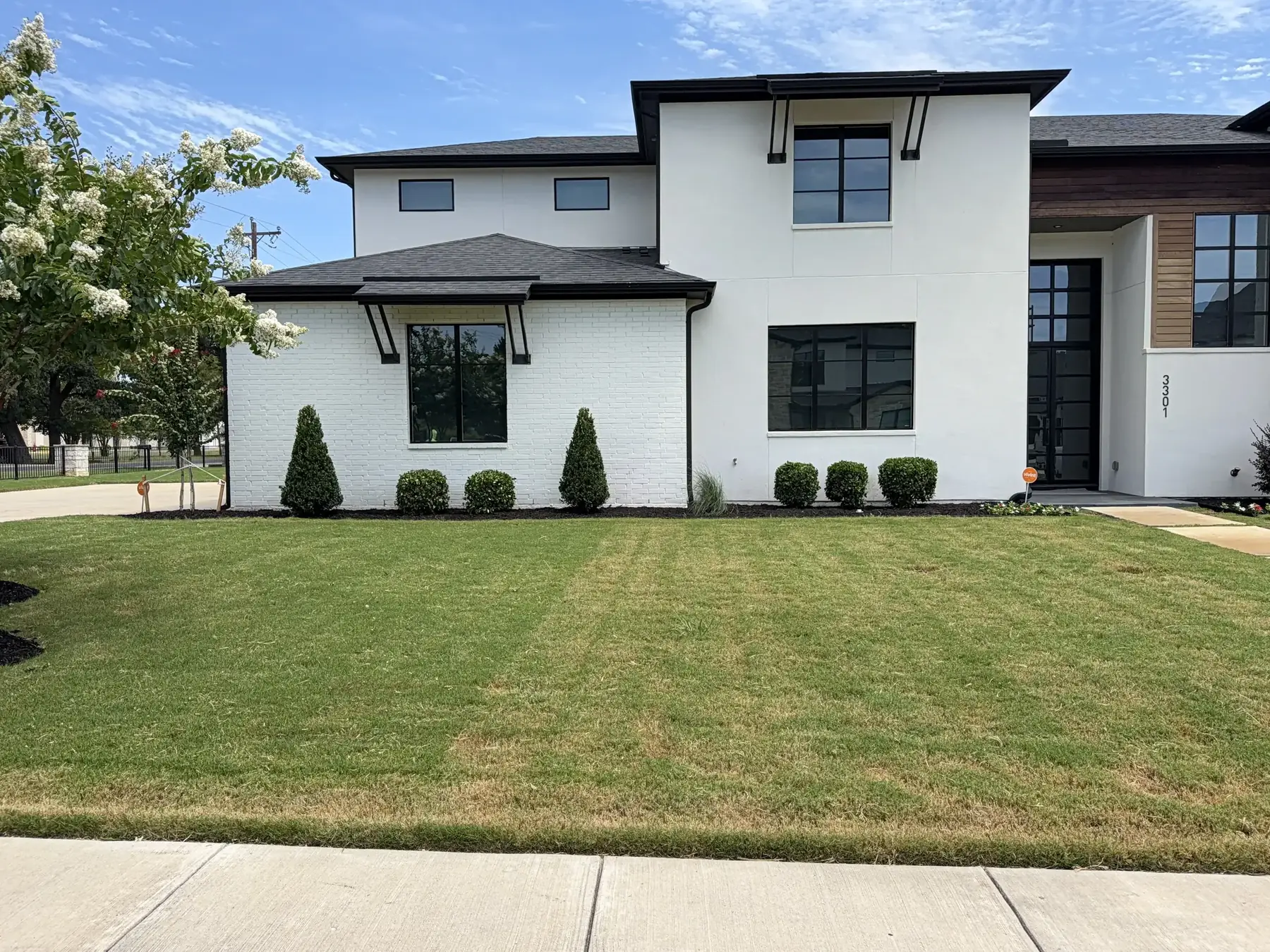
Per-visit rates, seasonal totals, and the acreage distinction that no national cost guide makes, but which decides the price on half the properties around here.
These are market ranges for the Dallas-Fort Worth area, gathered from published contractor pricing and cited where we have it, not a Semper Fi price list. Your number depends on your yard. The point of this page is that you can walk into any estimate, ours included, knowing roughly what things cost and what should be in the scope.
| Scenario | Published range |
|---|---|
| Dallas, average residential yard | $35 to $67 |
| Dallas, general | $33 to $70 (about $50 typical) |
| Dallas, standard quarter acre | $40 to $60 |
| Fort Worth, mid-size (~8,000 sq ft) | $55 to $80 (about $65 average) |
| Over half an acre | $75 to $120 |
| Per acre, Texas | $60 to $150 |
| Two acres and up | $278 to $449 per visit |
Dallas and Fort Worth both sit toward the top of the statewide band. The half-acre-plus and per-acre figures are national model data, not DFW surveys, which brings us to the important part.
This matters across Double Oak, Argyle, Bartonville and Copper Canyon, where two- and three-acre residential properties are ordinary rather than exceptional.
Cost guides price lawn care by area, as though a lawn were a uniform surface. Real properties are not. The expensive part of maintenance is not open turf: a sixty-inch zero-turn covers that fast. It is everything you have to slow down and trim around.
What actually sets the price on an acreage property:
Plenty of properties here are two to three acres with perhaps three-quarters of an acre of genuine lawn and the rest pasture or natural. The correct approach is to price the maintained area at maintenance rates and handle the remainder as occasional pasture mowing, which is a far lower per-acre service. No national cost guide makes this distinction, and it is the number one reason homeowners here think they are being overcharged.
We could not find any DFW-published pricing for one-to-three-acre residential maintenance. Rather than dress a national average up as a local figure, we will say plainly: that number comes from walking your property.
Dallas pricing for a five-application program running April to September:
| Lawn size | Per application | Annual (5 apps) |
|---|---|---|
| Small (under 3,500 sq ft) | $64 to $146 | $255 to $585 |
| Standard (5,000 sq ft) | $85 to $195 (~$130) | $340 to $780 |
| Large (10,000 sq ft) | $157 to $361 | $629 to $1,443 |
| Half acre (22,000 sq ft) | $332 to $761 | $1,326 to $3,042 |
Organic programs run 35 to 45 percent higher. Bundling aeration or overseeding saves 10 to 15 percent. A Fort Worth cross-check comes in materially lower at $75 to $115 per application, which is a good reason to treat these as a range rather than a quote.
| Service | Cost |
|---|---|
| Aeration (Fort Worth, mid-size) | $135 to $215 (~$170) |
| Aeration (general, by size) | $75 to $250 |
| Aeration bundled with fertilization | $210 to $430 |
| Overseeding | $100 to $180 |
| Fall cleanup / leaf removal | $110 to $215 |
| Leaf removal, Dallas quarter acre | $185 to $260 |
| Leaf removal, Dallas one acre | $415 to $1,040 |
That last figure is the Argyle and Double Oak reality: mature canopy on an acre lot produces a genuinely large seasonal line item, and it surprises people every year.
Warm-season turf in DFW grows from roughly March to October. That is about 30 to 35 mowing weeks against roughly 22 in a northern market. Even at similar per-visit rates, the season is simply longer.
Two other local factors:
Aeration matters more here. Compacted clay makes core aeration a higher-value service in North Texas than in sandy markets, and it is the correct annual pairing with feeding for Bermuda and Zoysia.
Watering restrictions constrain the whole picture. With outdoor watering limited across most of this area, lawn health depends more on cultural practice, mow height, aeration, soil condition, than on inputs. You cannot simply water more when the turf looks stressed.
Published Dallas figures put a standard residential visit at roughly $35 to $70, with about $50 typical on a quarter-acre lot. Fort Worth data for a mid-size lawn around 8,000 square feet runs $55 to $80. Multiple sources note that Dallas and Fort Worth trend toward the high end of the statewide range.
Honestly, this is where published data runs out. We found no DFW-specific pricing for one to three acre residential maintenance, and we would rather tell you that than invent a local number. National figures suggest $60 to $150 per acre in Texas, with half-acre-plus properties at $75 to $120 per visit and two-acre-plus at $278 to $449. Treat those as directional. The real number comes from walking the property.
Because mowing cost tracks perimeter and obstacle count, not area. Open turf is fast; trimming around post oaks, fence lines, septic markers, well heads, propane tanks and outbuildings is slow. Cost per acre falls as acreage rises even though the total goes up, and a heavily treed half acre can genuinely cost more to maintain than a wide-open acre.
No, and you should not. Many Double Oak and Argyle properties are two to three acres with under an acre of actual maintained turf and the rest pasture or natural area. Those are two services at very different rates. Quoting the whole parcel at lawn rates is the single biggest cause of sticker shock in this service area, and it usually means whoever quoted it never got out of the truck.
For a 5,000 square foot lawn in Dallas, published pricing runs $85 to $195 per application, around $130 typical, with a five-application program running April to September at $340 to $780 a year. A Fort Worth cross-check comes in lower at $75 to $115 per application. Organic programs run 35 to 45 percent more. Bundling aeration with fertilization typically saves 10 to 15 percent.
Biweekly is cheaper per month and often more expensive per season. At roughly $50 a visit, weekly service March to October is about 35 visits, near $1,750; biweekly is about 18 visits, near $900. But Bermuda in a wet North Texas May will outgrow the one-third rule between biweekly visits, and the recovery cuts, double-cutting and scalping fees that follow tend to erase the saving while stressing the turf.
The number we give you is the number you pay. Here is that from people who are not us:
Stuck to budget, stuck to timeline, 100% pricing transparency, can't ask for much more than that!…
Thank you for your review! We're glad you appreciated our transparency and timeline adherence.
Very responsive, excellent communication, the best customer service mindset. All great! Justin is the best.
Thanks so much for your awesome review! Our team, especially Justin, really appreciates your kind words!
Justin was fair, transparent, on-time, and a great communicator. He spent time figuring out the mapping of my sprinkler…
Matt, thank you for trusting in us. Thank you for your service to our Country. From one Marine to another Semper Fi!
Ranges can only tell you so much. The things that actually move a price are your grade, your soil, how far the water has to travel and what is already buried out there, and none of that can be seen from a spreadsheet.
Justin will walk your property and give you a real number, in person, for free.
Tell us the basics and Justin will come look. Free, no obligation, and you get a real number instead of a range.
Prefer to talk it through? Call (469) 400-9581. You’ll reach Justin.
French drains, catch basins, regrading and downspout tie-ins for North Texas clay soil.
See the ranges →Bermuda, Zoysia and St. Augustine sod installed with real soil prep and a watering plan.
See the ranges →Full-property design and installation built around your lot, your light and your soil.
See the ranges →Paver and stone patios, retaining walls, walkways, fire pits and outdoor kitchens.
See the ranges →Seasonal trimming, crown thinning, clearance work and shrub shaping with haul-off included.
See the ranges →